Shanghai review (Activision, PC Engine, 1987)
Tile away the hours
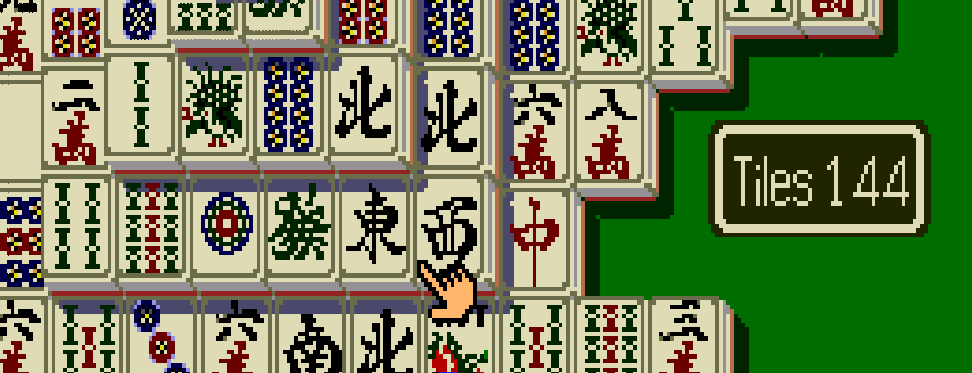
When I was a child, if you had opened the door to the locker I was stuffed in and said to me, “Paste, what is Mahjong?”, I would’ve simply replied “People don’t call me paste yet. But to answer your question, Mahjong is the game where you have to match the tiles to clear the board.” Boy, was I partially correct.
Mahjong is a four-player competitive game with tiles that works kind of like the card game Rummy. Mahjong Solitaire is a single-player game that uses the tiles from Mahjong, but that’s pretty much where the similarities end. Your goal is to eliminate all of the tiles on a “turtle” shaped board by matching them. You can match any tile with one of its identical quadruplets or, in the case of flower and season tiles, with any other flower or season respectively. The only other conditions are that the tiles cannot be sandwiched between tiles on both their left and right and there can’t be a tile even partially on top of them.
As a kid, I occasionally got to play Mahjong Solitaire on Windows 3.1 where it went by the name “Taipei.” For some reason it wasn’t always present on Windows machines and I was never sure why. It was one of my favorite Windows Entertainment Pack games, right up there with Chip’s Challenge, which is actually pretty unpleasant to play. I only ended up beating Chip’s Challenge last year, that time for the Atari Lynx, and I don’t recommend trying to do that. Taipei, however, always seemed like a treat when it showed up on some school computer, a little diversion I could use to unwind after a long day at the pre-office. Just match some tiles and relax.
Shanghai is the TurboGrafx-16 port of Activision’s version of Mahjong Solitaire. Along with Bikkuriman World, it was one of only two launch titles for the Japanese launch of NEC’s PC Engine, the TurboGrafx-16 if you’re nasty (North American). It was just as relaxing as I remember Taipei being, and a bit addictive. I made it my mission to beat all the preset “sequence” boards, not a bit influenced by the list over at Retro Achievements.
There’s not much to tell about the game. You match tiles until there are no tiles. You can occasionally get stuck: for example, if I trap one of only two season tiles left between the last pair of red dragon tiles, but one of those red dragon tiles is also trapped between the two remaining season tiles. Good luck envisioning that without experiencing it! Otherwise, you may just have a tile you need stuck underneath another tile you can’t remove. These are both remedied by knowing which pairs of tiles need to be removed first, although this may require some trial an error since most of the tiles are obscured from view at the outset. On two or three of the sequence boards this turned out to be a huge pain in the ass, requiring a significant number of replays before I could suss out which tiles I should remove when. The whole list of 50 boards took me about 33 hours total to beat.
The only thing that might have sped that time up might have been if there was a mechanic in the game to let you know when you have no moves left. There is not. It’s quite easy to overlook possible moves, and more than once I found myself scanning over each individual tile looking for a possible match, only for it to end up opening up the entire board allowing me to clear it. A little “don’t waste your time looking” when moves were exhausted would have been a nice touch. “I sure hope they put that in the sequel!” I say, surely not having already played it.
I ended up with a sort of Tetris Effect… uh, effect on my brain with all the scanning and matching where I would lay in bed at night, imaginary sets of tiles presenting themselves to me, unbidden, and with me having nothing to do but look for matches. Thankfully, they were not accompanied by what was, I think, the only tune in the game (it appears there are four in total, but I swear I only heard one), an about-15-second-long looped melody with a droning tone underneath. The volume was turned down by the second board.
Can you beat Shanghai for the PC Engine? It depends. I can’t be sure, but unless you select specific sequences, you are given what seems to be a procedurally-generated board. However, you are given a reward of sorts if you beat four boards in a single play session. This condition is given much more lenience when playing on an handheld emulator that you can put into sleep mode and turn back on to restore an unbeknownst-to-the-game paused session. What you are given is a series of images after each completed level, each more revealed than the last, of a whiskered dragon, the final one being the full picture. Yay!
The other way of beating it is to play all the sequences, but you are given no indication that you have been acknowledged as doing that. Any board you beat after the first four shows you the same full dragon picture again.
I’m simultaneously proud and sad that I’ve finished all the sequences, as it gave me a small sense of accomplishment, but I have no more boards to do. I mean, there are still the randomized boards, but as with the levels Hexcells Infinite, they just don’t have the same appeal to me as the curated ones.
In the end, Shanghai was a pleasant time waster, a nice thing to do while listening to a podcast or low-visual-intensity youtube video, and it had very little to do with the city of Shanghai.