Maptroid: Worlds review (Lozzajp, PC, 2022)
I want less!
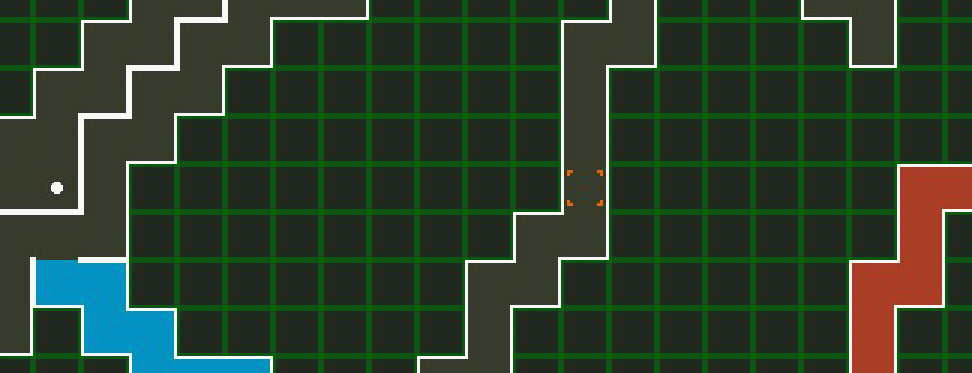
Not long ago I played a game called Maptroid on the can-you-believe-it’s-still-around “educational” video game website coolmathgames.com. The premise is simple: it is a metroidvania, but without the pesky direct control over a character. Instead, you control where you are on the map and can only see the map and map accoutrements. “You” are the cursor on the map and the goal is to fill out the map by traversing it. It is very basic, but it is also very chill. I had a good time playing it.
I only found out about Maptroid because I saw Maptroid: Worlds on Steam. After coming back from Maptroid, I wishlisted Worlds and today I decided to buy it. After all, it was only three bucks, and I had a good enough time playing the original to splurge on what I assumed would be another go at a similar experience.
I was right, mostly. The gameplay is almost identical as the first game, but slightly expanded. After starting out on a tutorial map of your home planet, you blast off into the galaxy map and move your spaceship cursor toward various planet map icons. On said planet maps are interconnected color-coded squares that appear as your cursor approaches them, color-coded key-locked door symbols, and the occasional item icon.
Some items are the key to progression as they allow you to breathe underwater or resist lava. What this means in practice is that you can move the cursor over the blue squares and the red squares. There are also keys that let you open those doors you’ve been hearing about and some items that improve your view distance. The vast majority of items, though, are collectibles that offer you a bit of lore for the world that I couldn’t have cared less about. Some are “Rexsoft Wiskipedia(sic) disks” that you can’t even access the information from without some other item whose name I forget, but when you can, hold on to your butts for thrilling information such as the high and low temperatures or length of the day of the planets you visit.
The writing in the game is jokey enough to let you know that the lore isn’t to be taken seriously, but I mostly skipped over the flavor text of the items, just skimming them to see if there was any crucial information that I needed to glean. Usually there wasn’t.
The original Maptroid was a mellow experience. There were no frills, but that was the appeal. The calm and even filling up of the unexplored space was a soothing exercise, slowly increasing the completion percentage toward one hundred without threat or worry.
Worlds both understands and misunderstands its precursor’s appeal. The main game has a relaxed soundtrack, evoking memories of Metroid while avoiding its sharp and paranoid tones. Filling out Worlds’ map was pleasurable, but also frustrating at times.
Take, for instance, the teleports. There are several teleport icons on the map, with no indication as to where they go. Many go only to a small map section, two to four cells in size, containing only another teleporter. Some go to other planets with no icon to allow you to return to where you came. I figured out later that the “Tele” ability you pick up allows you to go the Teleport Room which contains all the one-way teleporters. All of them simply allow you to go to the other planets you can already access with your ship, however. The relative sameness of the planets makes teleporting disorienting and less optimal than simply traveling where you want on the galaxy map.
Much of the teleporting is also made redundant after obtaining the phaser ability, which allows you to pass between walls on the map. It doesn’t allow you to bypass keyed doors, but plenty of those can just be circumvented by moving one cell to the side.
The ending sequence may have done the most to jar me out of my mellow experience: After passing through a few locked doors, I get a flavor text that I don’t really read, and then all of a sudden there is a countdown timer, I can’t go back the way I came, the screen shakes and a siren blares. There is then a somewhat hectic escape where you just go to teleporter after teleporter until you run out of teleporters. It was fine I guess. The End.
There are a few other modes the game offers. The first of these is Mole Mode, which seems to be the same as Story Mode, but almost none of your map is revealed. You only see the current cell you occupy, the location of your ship, and any doors or items you obtained. It was pretty annoying and I didn’t bother finishing it. It looks from the Steam achievement percentages to be the least completed task in the game.
Puzzle mode, on the other hand, is (usually) the most fun of all other modes. There are forty levels, each with a different premise aside from a few that are repeated once or twice. These all use the basic Maptroid controls of moving around a grid, sometimes using an action button. Examples are sokoban, snake game, nonograms, and slide puzzle. Some are cute, some are memes. The only truly annoying thing about puzzle mode is that when you complete a level, there is a one or two second delay before it tells you it’s completed, so I would just sit there like a doofus sometimes before a “you did it!” dialog box popped up or worse, didn’t pop up.
There’s a speed run mode that I didn’t bother with. I’m sure it was great.
The last mode is Zentroid. This mode is just pure filling out a map, with again forty levels available to you. Each map in this case is a picture, and you can increase your “brush” size to fill out more of the map at a time. I always changed it to the maximum brush size for this mode, especially since some of the pictures were huge. Unfortunately, the game would never remember this decision, so I had to change the brush size every time I started a new map. The game also would not remember my sound options from session to session. I think every Zentroid map was a reference to either a meme (this game loves the doge meme), or another video game.
In the end, I think the original Maptroid was all I really needed. Worlds didn’t add much to the experience, and it wasn’t an idea worth fleshing out, especially considering that the whole premise of the game in the first place was to strip a metroidvania to its bare bones.