The Wit.nes (demo) review (dustmop, PC, 2016)
Links to the past
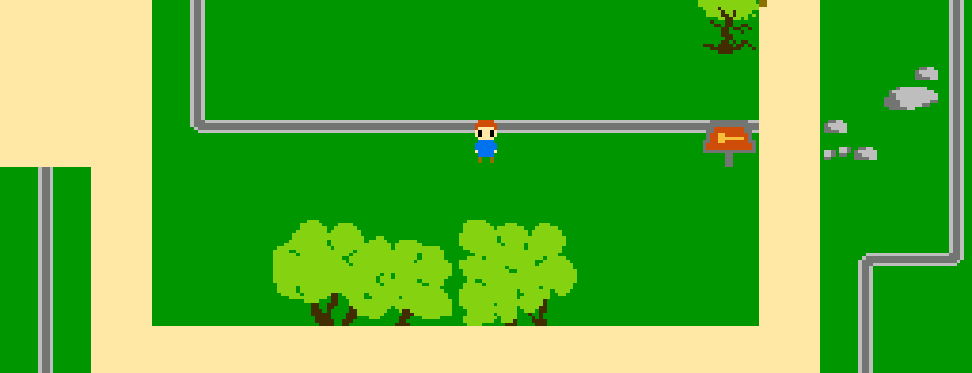
If you’ve ever wondered how the first few minutes of Jonathan Blow’s/Thekla, Inc’s 2016 puzzle game phenomenon The Witness might’ve looked if it was developed for the NES, then you have quite a specific imagination. Nevertheless, homebrew NES developer dustmop had that in common with you and brought your thoughts to lo-fi life.
I came across The Wit.nes while putzing around on RetroAchievements, looking for interesting games. I was a big fan of The Witness, so this seemed right up my alley. Short, retro, puzzley; The Wit.nes ticked all three boxes for me. I immediately downloaded it from dustmop’s itch page and let it sit in my rom collection for two or three years. Okay, it was more like a couple of months, but such a short time frame really is an exception for me.
No instruction manual needed, I just turned on the game in an NES emulator and started virtually walking around and figuring out what buttons do. Without the first-person mouse and keyboard or analog controls of its namesake, The Wit.nes has you D-padding around a top-down overworld maneuvering your avatar toward little screens that are or are not powered up. Press A to initialize the puzzle your top-down avatar is facing, and the scene changes to the puzzle mode. Press A again for some reason to make a white dot appear on the puzzle board from which a line must be drawn to the nub signifying the end of the simplistic maze-like board. Sound familiar? The B button cancels out of the puzzle screen (causing the puzzle to reset) and can be held down for running in the overworld instead of walking.
After the introductory ones, puzzles comes in three varieties with about eight of each of type. I’m pretty sure that each style of puzzle is represented in the original, but it’s been so long that I can’t be sure of it, much less whether there are any of the exact same puzzle layouts. Half the fun is figuring out how the puzzles work, so I won’t go into specifics about that.
Any puzzle type can be tackled at any time, but within one type they have to be completed in order. The first unlocks the second of that type, the second unlocks the third, and so on. Once all three styles of puzzle have been completed, a final puzzle is available and then you’re done. The whole ordeal took me maybe, maybe, 20 minutes.
The Wit.nes is marked as being a demo, but I don’t see any activity since its release year, so I’m not holding out for a more fleshed out game, but that’s okay. The game doesn’t nearly overstay its welcome, and the price is pay-what-you-want, as little as $0, so there’s no excuse to not bear Wit.nes!