Uniracers (DMA Design, Nintendo, SNES, 1994)
Gotta go fast! (but as a unicycle)
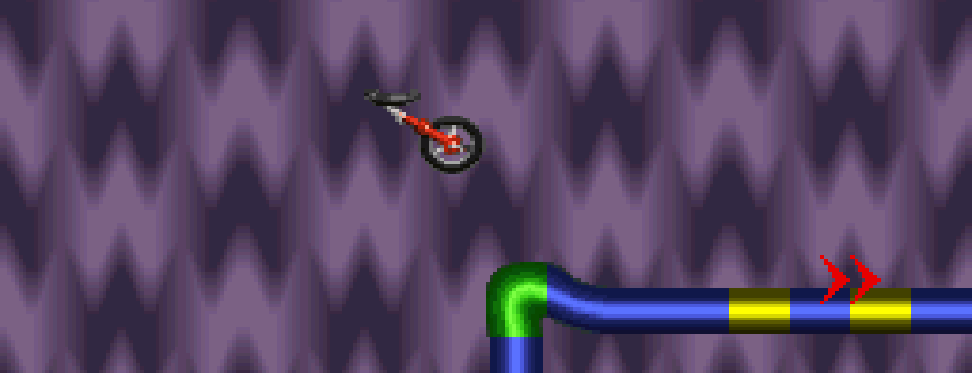
I’ve played a lot of games like Uniracers before but I’ve never played a game like Uniracers before.
At its heart, Uniracers is a racing game, and I have played my fair share of racing games. The layout is a little different than your typical racer. This is not the over-the-shoulderish view of a Mario Kart nor is it the frozen three-quarters view of a Super Off Road. This is a side-scrolling racer rivaling the speeds of Genesis era Sonic, Nintendoing what Sega thought they could not.
In Uniracers, you control a sentient unicycle, the only kind of denizen in the Universe of the Uniracers, unless you count the Unigod (which is integral to the story, so says the manual). You are born to race, and race you shall against either a second player or the ghost provided to you and THAT’S IT. There are five tracks in each of eight Leagues, which I thought went from easiest to hardest, but in reality it’s more like going from easiest to moderately difficult, with the graph of difficulty of the intermediate levels looking like an EKG. Each league has four races and one stunts level, the aim of which is to rack up a qualifying score doing tricks for one minute.
Races for each League have a Bronze, Silver and Gold difficulty level. You have to finish all the Bronze races before you get to the Silver and all the Silver before the Gold. All that changes between the difficulty levels is the skill of the ghost competitor in the races and your qualifying score in the stunt levels. You may have already gotten, say, a Silver level race time on your Bronze attempt, but you are going to have to do it again if you want to get the Silver medal. It’s a weird format, but I’ve seen worse. It provides a better difficulty curve than going from League to League, although the 7th and 8th Leagues only unlock after earning the Silver medals in the preceding six, so when you start out on their Bronze levels, it’s back to Easytown for another ten tracks.
Tracks are laid out in two dimensions, often going left or right but nearly as often going up and down, looping and twisting. The track design is just a line about as thick as the diameter of your wheel. The colors of the track change to give you a bit of context as to what’s coming up, e.g. blue and green stripes for a tricks area, red/blue when you need to stop doing tricks, yellow for a shortcut or jump, etc. These help you to a degree, but for the harder target times it’s more useful to just memorize the track. This is easier than it sounds because 1) the tracks are fairly short with a lap maxing out at around 45 seconds and 2) the colors jog your memory as to what’s coming up. Uniracers is ahead of its time in that restarting a level is pretty quick, something that didn’t really solidify in game design until more than a decade later, so even if you’re replaying a level 20 times, it’s all happening in very rapid succession.
Tricks are possibly the most important part of gameplay in that they give you speed boosts when you land them successfully. If you land them unsuccessfully on Silver or Gold, you may as well just start the level over. The more skillful the trick, the more of a boost you get. Your opponent will also do tricks, but once you get used to landing quick Loop-plus-Twist combos, you can easily outpace them on straightaways. The difficult and often frustrating part is trying to identify where and when you have enough time and flat track to reliably land your tricks. Tracks often suddenly require you to change direction, lest you push against a boost the wrong way and lose momentum. You may also accidentally land a jump onto the upward slope of a loop, necessitating a painful reverse to build up the required speed to get to the top. Worst of all, you may just fall off the main track altogther into the dreaded red/yellow zone that earns you some significant backtracking and thumb fatigue.
Even if you’re good at tricks, you have to be really good to achieve many of the Gold times and scores. Silver times gave me a significant challenge, and I didn’t end up getting all the Golds before shelving the game, though I may come back to it. More than once my unicycle crossed the finish line a mere hundredth of a second after my opponent, and there was even a time that I got a draw, which should be illegal and does not count as a win. TRY AGAIN. Any time you don’t land a flip in the right place or at the appropriate angle relative to the track could mean a loss. Thankfully the quick restart eases the pain if not the tension.
The music wasn’t bad, and according to the internet, there are five different tracks they use for the main races, but if you had asked me before I would have thought there was just one. They are all up-tempo and exciting with guitar licks. Very appropriate for the mood, but not very memorable. My attention was probably entirely focused on the race. There is little time for relaxation in any of the races.
I played my whole playthrough as “Mike”, the default name of one of sixteen Uniracers you can choose to play as. As far as I can tell, they are all identical except for their color, and they essentially play the role of different save files. I didn’t realize the game was being saved, and when I looked up online when the game was being saved, an AI overview lied to me and said that the game did not have a battery backup. In any case, I can always come back and try for the Golds later, which I probably will. I recommend you give it a shot, too, since it is very easy to pick up and play a few races without any real commitment.