TUNIC review (TUNIC Team, Finji, PC, 2022)
Look again
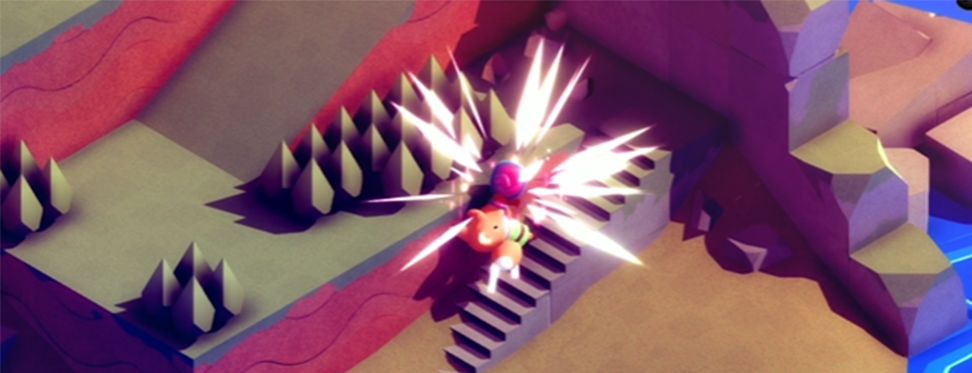
At first glance, the screenshots of TUNIC tell any Zelda fan where it draws its inspiration. Upon playing it though (or from hearing about it from those who love it), you find the ingredient that pushes it past most games in Nintendo’s franchise. TUNIC is soaked through with riddle-like puzzles that far outclass the square-peg-in-square-hole tasks found in most Zelda games.
Moments after starting TUNIC, the game showed me in the form of a camera-hidden, explorable passage what would be the key to my playthrough: careful observation. Each area and each page of the in-game instruction manual, in fact what feels like almost every object and every nook and cranny on every screen of the game demanded careful scrutiny. The slow leak of tutorial information through collection of manual pages allows you to play better, but also see better, finding puzzles where you had thought there was nothing. This trait of TUNIC’s brings to mind Toki Tori 2+, a side-scroller where you have the ability to go anywhere right from the beginning, but not the knowledge of those abilities, a hallmark of the exploding genre of the metroidbrainia.
The accumulation of knowledge in the form of the manual will only get you so far, though. More esoteric and rewarding info comes to the player only through the gauntlet of note-taking, deciphering and re-exploring that I was only inspired to do about “halfway” through the game. Halfway here is in quotes, since while the running around, slashing, and collecting for the first half of the game was probably a roughly equal amount to the running-slashing-collecting time on the far side of the note-taking decision, the latter “half” was occupied by another equal amount of time writing, comparing, translating and planning, whether looking at the screen or not.
TUNIC’s combat is also a challenge, with the as-of-late common mechanic of leaving behind a ghost containing, in TUNIC’s case, (thankfully) only some of your coins, which you can return to claim after resurrection. At first, even the simplest mobs present a challenge, but once you understand how those enemies work, they quickly shrink into nothing more than minor obstacles and coin suppliers, especially after you acquire (and learn how to use) upgrades. Like in Zelda, your movement upgrades, primarily used for accessing previously unavailable areas, are also incorporated into battles, which serves to liven up the sometimes somewhat monotonous attack-and-roll tactic that is frequently sufficient for success. TUNIC does, however, thankfully avoid the trope of pre-Breath Zelda of having to use the item found in a dungeon in order to defeat the boss of that dungeon.
Bosses present what at first appears to be an impossible challenge. The health bars are long and the damage they do with each attack is significant. Most are also hulking monsters that take up most of the screen, an intimidating sight for a player character who may just be wandering around with a tree branch. After a few attempts and some in-game hints/suggestions, they are all eventually surmountable. I ended up cheesing one of the bosses, but it was the exception. Most telegraph their moves enough for you to react, but only just. The stamina cost of the roll governs your moveset just enough to give you the feeling of being capable of handing what gets thrown at you, but still require you to be on your toes for the durations of the fights.
The soundtrack lends itself well to the mood of exploration, consisting of ambient tracks that, while not having any melodies I could hum for you from memory, did reinforce the feel of the environments well. The soundscapes matched the art style, with its softness, its smooth textures and its doll-like character and enemy design, also reminiscent of the top-down Zeldas for the Switch. The place where I thought the soundtrack was a bit unorthodox, if not out-of-place, was in the boss battle sequences, which didn’t mirror their difficulty and anxiety.
I experienced a few minor bugs, clipping through the scenery and falling through the bottom of the world, due to the nature of one of the movement skills, but these were fairly rare, so much so that they barely register in my appraisal of the game.
Being a big Zelda fan but also a big puzzle game fan, I thoroughly enjoyed playing such a thoughtful action-adventure game. This game style is a refreshing experience that happens far too infrequently, the last one of which comes to mind for me being the Ittle Dew duology from almost 10 years prior.
Click for SPOILERY STUFF
The more I played through TUNIC, the more I saw the looming necessity of translating the in-game language. At first I just associated words here and there in the manual with the concepts I thought they represented. I had heard somewhere that it wasn’t a mere Caesar cipher (a one-to-one replacement of letters with other letters, or in this case runes), so I tested a hypothesis. I changed the in-game language from English to Spanish and saw that the runes did not change. This was unfortunately not the behavior one should expect, having full knowledge of how the cipher works. Even with the language changed to Spanish, the runes still represent phonemes of English words. This impeded my efforts until I realized the disparity, and was a bit of a disappointment given how much care was given to all other parts of the game. It may also significantly hinder non-English-speaking players, which seems unfair. I know that translating runes to other languages would be a much larger effort that merely translating in-game English text, but I think it’s inappropriate to advertise it as being available fully in those languages.
There are some puzzles I didn’t end up finishing, or even halfway knowing about, such as the ARG parts, but what with everything else in the game being fully self-contained, even the manual, the extensiveness of the non-self-contained bits didn’t appeal to me.
There were also some puzzles that required extensive input without errors, such as the one for the large door on the mountain. This meant I ended up inputting very long sequences multiple times while testing out different theories about how the puzzle could be solved. These were very much the exception, though.
The last thing I’ll say is that I very much enjoy this style of exploration interweaved with puzzle-solving. It is a different animal from the usual, strict this-is-the-puzzle games one normally encounters in the puzzle genre. They are both great; I just hope people keep making more of this kind.