Dungeon and Puzzles review (Nekolyst, PC, 2021)
What it says on the tin
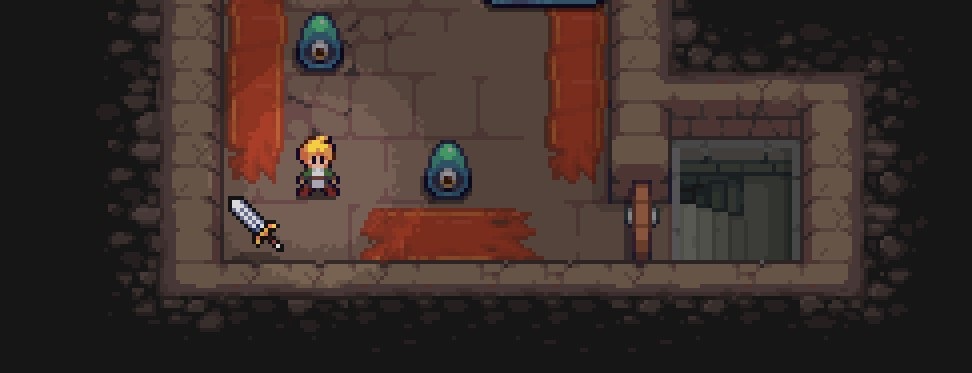
It took me around 80 of the game’s 150 total puzzles to consciously put the label “sokoban” on Dungeon and Puzzles. From Chinese developer Nekolyst, consisting of only one person (although with some assets from elsewhere), D&P is a prosaically-named top-down tile-based puzzle game where you kill monsters so you can open the door so you can get to the next level(s). Monsters are slaughtered using gear that needs to be collected in each self-contained level, namely a sword, a bow and arrow, a shield (for bashing enemies onto spike traps) and/or a gauntlet (for yanking enemies onto spike traps)
You navigate each level by moving up, down, left or right, but contrary to many other sokoban games, your character continues in that direction until they hit a wall, an item, a monster, or furniture, the latter three of which can be moved using the shield or the gauntlet. Each level has a target number of moves that you can complete the level in and often even get below (there is an achievement for doing this at least once) in order to earn a gold crown on the level. Most levels are very easy to do if you’re not concerned about target moves; most of the challenge (and for me, the enjoyment) of the game comes from trying to shave off one or two moves here and there or even completely reworking your strategy to ensure your head does not go bare.
The steam page for the game boasts a “[n]on-linear dungeon map”, but in reality this means little more than having occasional levels off to the side of an almost entirely linear path. When you beat a level, any adjacent levels are revealed, with dotted lines guiding you to where the next clump of levels will be located. You can forego a number of levels on the way there, but 1) who wants to skip levels in a puzzle game? and 2) you will miss out on unlocking “secret levels”, secret only in the sense that the map does not explicitly show you where they are before they are unlocked, so it’s a crapshoot whether or not beating a level will unlock one.
Much of the time, the first course of action I decided on would end up satisfying crown delivery requirements. Maybe some people want every single puzzle to be a brain-buster, a non-decreasing difficulty function as the level number increments, but I find the undulation comforting, the easier levels sprinkled throughout being brief respites for neuronal convalescence before the next punch to the mental gut. The limited space also acts as a de facto pressure release valve for what could otherwise be an agonizing exploration of endless alleys of possibility. But that’s sokoban for you.
There are three main places where the game suffers, two of which are closely related: First is that, even though this is a 2D pixel art game with minimal effects, controls can be unresponsive at times, with a half second or so delay of movement after input. Thankfully, it was relatively rare but still surprisingly existent for such a lo-fi game.
The second reason is that for some levels, especially from around the low 100s, the number of moves is just too damn high. I’m talking about levels that have a targets as high as 80 or so, meaning that if you’re not being parsimonious with your movement at every point along your move sequence, you’re going to end up undoing a bunch of moves, redoing a bunch of others, trying to remember which better paths you took, racking your brains to see where and whether moves can be lowered, trying different tacks and comparing numbers, over and over and over until you have all of them worked out.
Third is repetitiveness, another side of which could be seen as lack of creativity. I found myself often repeating similar kinds of strategies in a number of the levels. In some ways it felt like the premise of the game was not fully explored, or that there could have been more tweaks here or there to flesh out the gameplay somehow, but in the end it felt not fully explored. At the end there is a series of 5 levels in a row that are unavoidable in order to get to the last level, and one of them felt like it was requiring a new way of thinking, which ironically served to highlight the lack of that requirement in many of the preceding levels.
The music felt pretty generic and unobtrusive. I got the sense of it, but after the first few levels I usually played while listening to a podcast with the music volume very low and the effects volume a little louder than the music. The pixel art was also fine; it served its purpose, but I wasn’t wowed or anything. That being said, it was of higher quality and more subtle than many puzzle games one could find where the emphasis is on, say, matching a fully saturated key to the fully saturated lock of the same color.
I’d recommend Dungeon and Puzzles to the following people: people who like sokoban games, people who like puzzle games with a moderate challenge, people who want a chill puzzle game (not playing for crowns). I would recommend against Dungeon and Puzzles for the following people: action junkies, impatient players, puzzle gamers who want the intended solution to be maximally efficient or unique.
Overall: A fun moderately difficult puzzle game with a few hiccups.